My experience in Montessori education over thirty-eight years, spanning roles as a parent, school leader, adult educator, and on governing bodies provides a rich view of how Montessori’s constructivist design differs from other educational systems. This perspective considers the depth of Montessori’s scientific, hands-on and multisensory design which makes it unique in teaching and learning elements.
The View of Learning
Montessori instils an appreciation of all things, both living and non-living. The awe inspired by the environment engages the senses, fostering gratitude and curiosity.
The adult recognises the child as a “spiritual embryo” guiding them to self-construct through sensory exploration. By removing barriers to learning, the child is free to use their senses to develop their understanding, transforming both students and adults, as they share a journey of discovery, loving life and of learning.
Power of Relation
In a Montessori classroom, the teacher becomes a “learner among learners”. The teacher enables the student to practice self-determination through choice and resists interference. The teacher champions equity and peace, and by elevating the child they show that they value the hidden spirit that is unique to that child.
The child experiments with their learning in a safe space. In the adolescent community, the teacher works side by side with the students in various occupations that model skill and practice.
“The teacher becomes a learner among learners — championing equity, peace, and the hidden spirit unique to every child.”
Teacher’s Role
Montessori teachers raise the consciousness of the students. They facilitate learning individually, in small groups, and in a classroom community. There is trust in the child, in the process, and in oneself. They cultivate mindfulness and self-awareness which is embedded in day-to-day practice. Their skill in observation prior to introducing students to activities or experiences, is essential preparation to meet the needs of the students.
The scientific method informs their classroom planning for the teaching and learning cycle (Observe, Plan, Do, Check, and Act). The teacher prepares the total classroom environment to support self-determination and self-construction of the student. This involves order and organisation, teacher warmth and direction, three-year age groups, interesting work and Montessori apparatus.
The Teaching & Learning Cycle
Learner’s Role
Montessori learners are responsible for themselves, their environment and the community. They are active, working both individually, and collaboratively. They provide respectful feedback and support others. They recognise peers’ strengths without competition, valuing contributions as integral to the classroom community. Students participate in showcases, classroom meetings, parent meetings and conferences where they review their work progress and consider goals.
View of Knowledge
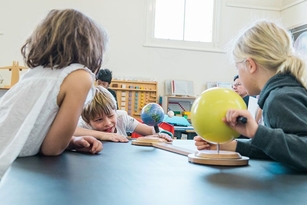
Attention is given to the development of the child with key characteristics for each stage and the nature of the learner. We consider the human tendencies and the sensitive periods for the planes of development. Our view is to focus on the big picture, and how everything is interrelated. When we present new knowledge, we relate it to what they know and then enable them with skills to associate and apply their understanding.
View of Curriculum
The curriculum is dynamic, but critically structured. We differentiate it according to the stages of development and present it as a continuum. The interrelated design incorporates the social, emotional, cognitive, physical and spiritual outcomes. The activities follow a framework for learning.
Learning Experiences

Emphasis in the Montessori classroom is on the prepared environment. The culture of the classroom is that it is psychologically safe, engaging, and physically appropriate. There are longer uninterrupted work periods that support creative flow. Students are given time. The atmosphere is one of calm, beauty, order, and routine.
Control of Process
Students are given freedom with responsibility. The processes are student driven rather than adult driven. Class rules at the beginning of the year are developed by the collective. Students are self-directed, there is clarity in communication of processes. The culture is of a deep consciousness of shared responsibility.
Motivation
Montessori’s intrinsic motivation approach is solidified through offering choice, trusting the process, and facilitating a love of learning.
Evaluation
We assess ‘for learning’ through observation, and assess ‘as learning’ through student reflections, self-assessment and conferences, and use of self-correcting materials, and assess ‘of learning’ with student outcomes that include wellbeing outcomes to include the social and emotional and moral development of students. We provide criterion-referencing record keeping which informs report writing.
Montessori’s constructivist design offers a depth of scientific, hands-on and multisensory activities that have unique teaching and learning elements that have been successful in Montessori schools and centres for over a hundred years.
Align your parenting with Montessori philosophy
For information on how parents can align their parenting style to the Montessori philosophy and classroom practice, consider taking a course in Positive Discipline for Parents — offered by Montessori Australia.
Explore the CourseAbout the Author

Elizabeth Goor
Director of Quality Management and Planning
Elizabeth Goor has been passionate for Montessori Education since 1986 and has over forty years of experience in leadership. She came to Montessori through her children and she has three grandchildren attending 6–12 classes in Montessori.
Her early background was in Health Services Planning, Research and Development; Accreditation; Adult Education and Community Services in Respite/Aged Care. She was Elonera Montessori School’s first Head and was instrumental in the stable growth of a school that started with one classroom to evolve into a school that offers all stages in Montessori education including the Adolescent program and the International Baccalaureate Diploma.
Elizabeth has an AMI Adolescent Orientation qualification, a Masters in Health Planning, an Honours Masters in Total Quality Management, an Education Diploma (Secondary Science), a Certificate III in Early Childhood, and trained with Mrs Duyker De Vries as well as attended MWEI. She is currently an active director on three Montessori not-for-profit Boards that advance education and research for the Indigenous Community; two not-for-profit Boards that support the advancement of Montessori Education; one private Montessori Board working with children that are disadvantaged or with disabilities.
Connect on LinkedIn